Things I like about samples.....
- Quick on and off the loom
- No worries about selvedges, treadling errors, uneven beat
- Learn a lot and move on

I'm comparing point twill and straight twill in both threading and treadling. Plus, the exercise in
Learning to Weave asks that you use 5 yarns:
- Regular size
- Thick
- Thin
- Bumpy
- Variegated

Thank goodness for the yarn table at the
New Hampshire Weavers Guild, where I purchased the warp and three of the wefts for this project.
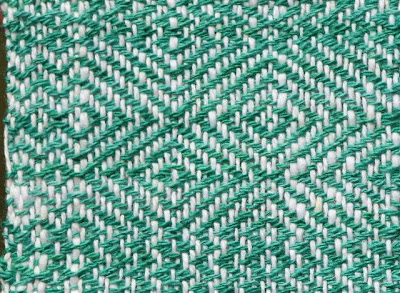
The green yarn is cotton that has been dyed somewhat unevenly. It doesn't look especially uneven on the cone, but in the sample the slight differences in the green really stand out. And not in a good way I'm thinking.
This blue cotton slub has some very thick bits. To me, using it in this twill looks awkward and bumpy and primitive. There are probably some weave structures where these yarns could look good together....but in this case I think the structure and the yarn are fighting with each other.

For my thin yarn, I'm using 20/1 linen singles. At the start of this section I couldn't figure out the beat. I ended up beating it twice with the shed open, and then again with the shed closed to pack it in tight. This piece of the sample is very stiff, but I like how the linen and cotton slub look together - even if it's hard to see in pictures.

This bumpy yarn is
Lion Brand Homespun left over from a charity knitting project. It's also variegated. The yarn looks surprisingly good woven. The variegation doesn't totally overshadow the twill.

This last yarn is variegated cotton left over from my days as a Big Sister (in the
Big Brothers / Big Sisters program). My little sis and I made Easter eggs by coating this string in some kind of fabric stiffener, then wrapping it around a balloon. After it dried, we popped the balloons. This was years ago! Probably before I had a digital camera - so no pictures, sorry.
Anyway, the variegation in this yarn overshadows the twill design. All I see when I look at this are the Easter egg stripes, not the twill pattern. (Especially looking at it in real life, as opposed to in this close-up photo.)
 Project Details:
Project Plan: Twill draft based on drawdown in Deborah Chandler's
Learning to Weave pg. 135.
Warp : White Cotton Slub
Weft: Various yarns described above.
Sett: 18 epi (2-1-2-1 threads per dent in a 12 dent reed)
PPI: Green: 22, Blue 16, Linen 38, Lion Brand 12, Easter Egg 25
Total warp ends: Approximately 60
Width on loom: 3.5 inches (9 cm)
Length on loom: 13 inches (33 cm)
Finishing: Cut, tie a quick fringe.

What I learned:
- Bumpy yarn often competes with a twill pattern making it disappear, or look more primitive.
- Variegated yarn sometimes competes with a twill pattern, also causing it to almost disappear.
- Subtle differences in dyeing can be more pronounced when using that yarn as weft.
- It is really hard for me to get into any kind of weaving groove with a table loom.
What I loved about this project:
- Samples: so quick and easy!
- Interesting to see how the yarns interacted!
- I could see that Easter egg yarn becoming something really cute.
- Great having a table loom handy so I didn't have to disrupt my other weaving to do this sample
- My favorite look was the linen with the white cotton warp.

Now I'm hoping to get one more sampler on and off this loom before I use it for a workshop in April!!
Related posts:
Start of this project: Learning to Like Twill


 Shed with beads down and floating selvedges


.JPG)


